Search
December 15, 2025

DNV Finds Long-term Optimism for Energy Transition

The 2025 edition of DNV’s Energy Industry Insights report finds long-term optimism that the energy transition will continue but widespread uncertainty about its direction in the near term. 

Trade agreements and tariffs drive the pessimism while growth of the world’s population, economy and need for electricity drive confidence that electrification — with its promise of greater energy security and energy independence — will continue. 

But the uncertainty has been palpable lately. 

The Global Economic Policy Uncertainty Index spiked in early 2025 as President Trump was hitting his stride in his second term and as DNV was conducting its survey. It eclipsed its previous record high, set in early 2020 as the scope of the COVID-19 pandemic became apparent. 

“To think that, by this metric at least, we are in more uncertain times than April 2020 shows just how much disruption and unpredictability there is in today’s policy environment, much of it caused by national issues, such as energy security, self-sufficiency and shifts in voter sentiment,” the authors write. 

By contrast, there is no doubt about the value prospect of electrification or the threat posed by greenhouse gas emissions, they write, and a successful transition remains possible, with sufficient investment. 

The transition also remains necessary, DNV Energy Systems CEO Ditlev Engel said in an April 29 news release accompanying the report. 

“A successful energy transition is not impossible, but the urgency to accelerate action has never been greater,” he said. “The path to a cleaner, more sustainable energy future is inherently complex and uneven, but delay is not an option. Immediate, coordinated efforts are essential to ensure momentum is not lost.” 

Lucy Craig, DNV’s director of energy systems growth, innovation and digitalization, said technology will play a critical role in the energy transition.  

“As the energy system becomes more electrified, distributed, interconnected and dynamic, adopting a whole-systems approach will be essential,” she said. “This means viewing the energy system as an interconnected whole, one that enables greater efficiency, flexibility and resilience.” 

Craig said 64% of respondents say a whole systems approach is impossible without fully digitalized infrastructure and 59% plan to boost their spending on digitalization, including artificial intelligence. 

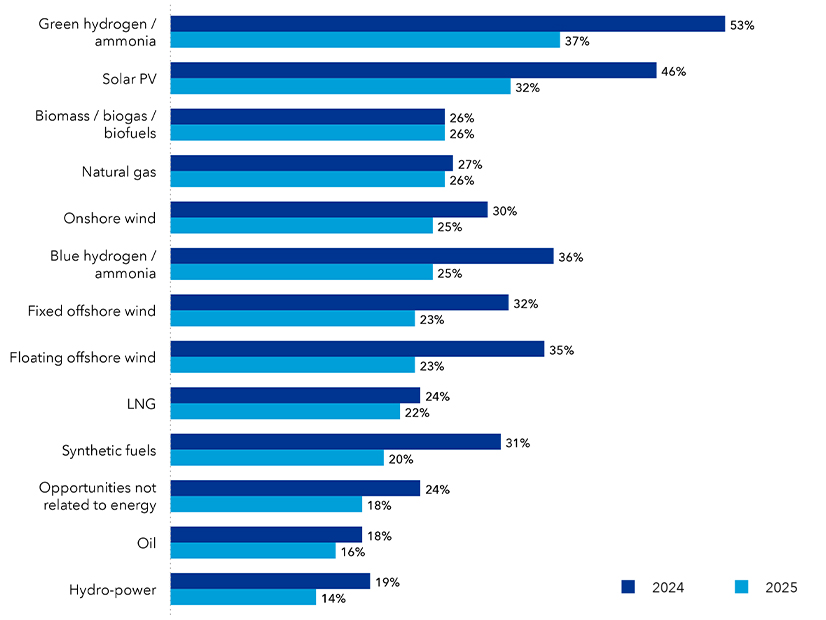
Data show planned 2025 investments in various energy technologies have decreased from 2024. | DNV

Some other takeaways from the 2025 report: 

    • 55% of respondents say the energy transition is accelerating, compared with 72% in 2024 and 79% in 2023.
    • 51% say a successful energy transition will negatively impact some communities.
    • 31% identify expansion of energy storage technologies as key to accelerating the energy transition.
    • 96% of those in the power sector see a need for urgent investment in grid modernization, and more than 75% see outdated grid infrastructure as a barrier to renewables adoption.
    • 50% of those in the renewables sector expect to meet revenue targets, and 43% are optimistic about profits, down from 75% and 67% three years ago.
    • 39% of those in renewables expect to increase investment in the next 12 months.
    • 31% identified expansion of energy storage technologies as key to accelerating the energy transition.
    • The top five barriers seen to investments contributing to the energy transition are policy uncertainty, capital outlay, regulatory constraint, profit limits and infrastructure shortcomings.

This is the 15th edition of DNV’s annual report.  

It is based on the comments of more than 1,100 senior professionals in the energy industry surveyed by the Norwegian company. They are heavily weighted toward Europe (54% of respondents) and Asia (22%), with North America third at just 12%.

The majority of respondents came from the renewables (35%) and oil/gas (33%) sectors, with the electric power industry third at 17%. 

BESS Companies Propose $100B to Grow U.S. Battery Industry

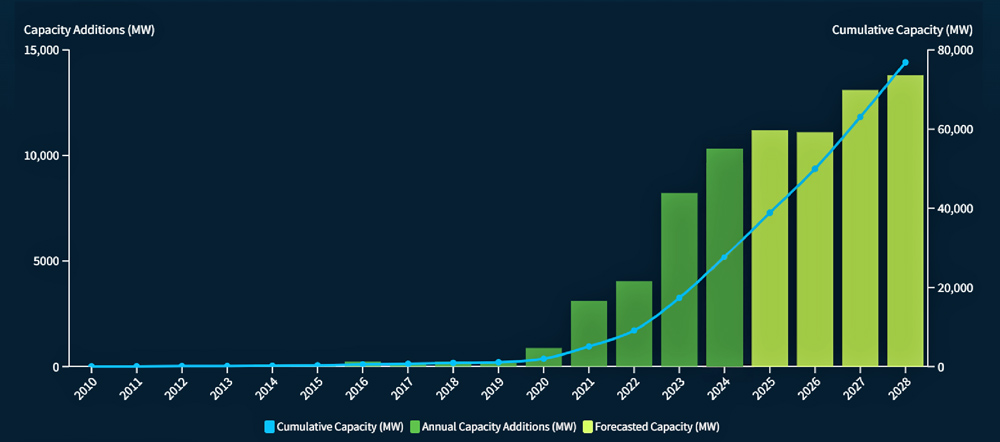
The U.S. energy storage industry proposes to invest $100 billion in U.S. grid-scale battery manufacturing and procurement by 2030.

The April 29 announcement came via the American Clean Power Association (ACP), and it came with a major caveat: A pro-business environment with supportive tariff, tax and permitting mechanisms will be needed if this commitment is to be fulfilled.

These preconditions speak directly to the uncertainty facing the U.S. clean energy sector since January, when President Donald Trump took office with a pro-carbon/anti-renewable message, and his Republican allies took control of both houses of Congress.

Threats of tariffs, the potential end of tax credits and rapid-fire policy changes have contributed to widespread pullback on manufacturing initiatives in the renewables sector.

The Clean Investment Monitor reported April 24 that while $9.4 billion in new clean energy manufacturing projects were announced in the first quarter of 2025, there also were $6.9 billion in cancellations, the most ever in a single quarter.

Against this backdrop, Jason Grumet, CEO of ACP, said the battery industry’s $100 billion commitment is important not only for the energy sector but for the nation itself.

“The energy storage industry is providing essential power when needed most while boosting domestic manufacturing and creating jobs across the country,” he said in the news release. “Today’s historic commitment will invest billions of dollars into American communities and position the United States as a manufacturing leader in battery technology that is critical to national and grid security.”

This is a variation of the message offered since Election Day by ACP and most other renewable energy advocates, emphasizing the economic, practical and political importance of clean energy investment and limiting or omitting any reference to its environmental benefits.

Data show the potential expansion of energy storage in the U.S. | ACP

Trump already has targeted offshore wind with damaging directives, despite that message. How effective the message will be in winning support for battery energy storage systems (BESS) remains to be seen.

Batteries can be an important counterpart for intermittent wind and solar generation, but here again, ACP played up the other roles BESS plays:

“Energy storage optimizes all existing power generation, lowering energy bills and hardening the grid against extreme weather events like blizzards and heat waves,” ACP wrote. “As the economy grows, energy storage provides important peaking capacity, freeing up more gas generation to serve as base load and enabling more energy production.”

ACP noted that U.S. battery installations have increased 2,500% since 2018; batteries saved Texas more than $1 billion in energy costs in 2024 alone; 25 new or expanded grid-scale battery factories are being planned or built nationwide; and storage projects are under construction in 31 states.

ACP said U.S.-made batteries could satisfy 100% of projected domestic energy storage demand by 2030 — if the support exists to grow the ecosystem.

“Without a pro-business policy approach that ensures enough certainty to sustain these significant investments, there is a risk that America loses out on both becoming a global battery manufacturing leader and meeting the economy’s rapidly growing energy needs,” it said.

Executives of Clearway Energy Group, Eolian, Fluence, Form Energy and LG Energy Solution Vertech voiced their support in the ACP announcement, which was accompanied by an expanded explainer citing major storage manufacturing or deployment projects by Fluence, Form, LG, Powin, Salt River Project/Ørsted and Tesla.

NERC Finds Growing Shortfall Risk in Canada

Interregional transfers are likely to become increasingly important to Canada in the coming decade, NERC said in a supplement to the Interregional Transfer Capability Study, with Québec especially vulnerable to energy deficiencies in extreme weather. 

The release of the Canadian analysis April 29 represented the conclusion of the study process that began with the passage of the Fiscal Responsibility Act of 2023, which ordered NERC to analyze current transfer capabilities between transmission planning regions in North America. The ERO also was directed to recommend prudent additions to transfer capability that could strengthen grid reliability and ways to meet and maintain total transfer capability. NERC released the ITCS in three installments, concluding in November 2024. (See NERC Releases Final ITCS Draft Installments.) 

The installments released in 2024 included transfers from Canadian provinces to the U.S., but not the other way around, and also did not study transfer capabilities between provinces. Congress mandated only that NERC study transfer capability within the U.S. But the ERO said in 2024 that the ITCS “would be incomplete without a thorough understanding of the Canadian limits and available resources.” Canadian government and industry stakeholders also requested that NERC extend the study to their territory, according to the supplement. 

NERC’s goal with the Canadian analysis was to apply “the same yardstick” that it did with the U.S. planning regions, Manager of Transmission Assessments Saad Malik said in a webinar accompanying the report’s release. As with the earlier components, the ERO developed its analysis based on historic weather conditions from 2019 to 2023, along with synthetic modeled datasets from 2007 to 2013, for a total of 12 weather years. 

NERC used the weather data to test performance of the regions across each hour of 2033, using the load and resource mix predicted in the ERO’s 2023 Long-Term Reliability Assessment, to identify potential energy deficiencies. The ERO then looked for transfer additions that could address them. 

A “potential for energy deficiency” existed in all 12 weather years for Nova Scotia, the report said, with five other provinces showing possible deficits in some years. Extreme cold weather drives the shortfalls in Québec and Alberta, along with one weather year in Saskatchewan; another weather year sees heat-driven shortfalls in Saskatchewan, with similar results across five weather years in Ontario. 

In all, the ERO recommended nearly 14 GW of additional transfer capability, which it said would address all of the resource deficiencies. By contrast, the U.S. component recommended 35 GW of added capacity across the U.S. planning regions but said even these additions would not be enough to resolve all deficiencies. 

The Canadian analysis noted that several provinces now have greater transfer capability with their U.S. neighbors to the south than with other provinces. For example, British Columbia has 2,170 MW of capacity into Washington state and 2,795 MW the other way, compared to, respectively, 855 MW and 1,000 MW into and out of neighboring Alberta. These figures apply to winter; summer transfer capabilities differ slightly in most cases. 

Ten gigawatts of additions were recommended for Québec alone, which the study noted is likely to experience difficulty meeting growing demand in the next 10 years, with which local generating capacity is not projected to keep pace. The additions were recommended from New York (4,200 MW), Ontario (2,600 MW), New England (2,600 MW) and New Brunswick (900 MW). Additional recommendations included:  

    • Nova Scotia: 500 MW from New Brunswick.
    • Saskatchewan: 500 MW from MISO West.
    • Alberta: 600 MW from Saskatchewan.
    • Ontario: 1,600 MW from PJM East (900 MW), MISO West (400 MW) and Manitoba (300 MW).

The MISO West-to-Saskatchewan and PJM East-to-Ontario transfers are potential new interfaces. 

In a media release, NERC CEO Jim Robb said the combined Canada and U.S. analyses represented “an unprecedented and vital assessment” that “provides a complete picture of the crucial role that interregional transfer capability across Canada plays in assuring the reliability and resilience of the interconnected North American grid.” 

California Lawmakers Seek to Trump-proof Pathways Initiative Bill

New amendments to California’s proposed Pathways bill will include protections against possible attempts by President Donald Trump to influence the state’s energy markets, such as pushing it to buy power from coal-fired generators.

Democratic State Sen. Josh Becker presented the proposed amendments during a California Senate Judiciary Committee hearing April 29. The committee unanimously approved all the changes in a late-night vote, sending the bill on to the Appropriations Committee.

The changes follow concerns from consumer advocacy groups like The Utility Reform Network (TURN) that handing over governance of CAISO’s energy markets to a proposed independent regional organization (RO) could undermine the Golden State’s clean energy goals. (See California Lawmakers to Discuss Amendment Requests to Pathways Bill.)

“Some opponents have raised reasonable concerns … and I appreciate those and will continue discussion,” Becker said. “I believe the committee amendments not only address these concerns but further strengthen the protections in this bill.”

Senate Bill 540, or Pathways, is the product of the work of the West-Wide Governance Pathways Initiative, an effort to support the expansion of CAISO’s Western Energy Imbalance Market (WEIM) and soon-to-be-implemented Extended Day-Ahead Market (EDAM) to entities outside California by creating a new independent RO to govern rules for CAISO’s markets while leaving key elements of the ISO’s balancing authority area intact.

Under the bill’s first iteration, California could not join the RO market before mid-2027. But with amendments, the timeline would be pushed to January 2028, according to Becker.

This gives stakeholders “a full three years of watching the new administration, seeing what it does and what it attempts to do regarding California’s energy markets” before any final decision is made, Becker said.

The amendments also clarify that the RO cannot establish capacity markets. This is to prevent the Trump administration from forcing California to buy coal, Becker said. He added that the strategy to use capacity markets to incentivize coal “is outlined by Project 2025.”

“We cannot establish capacity markets under this bill or establish any mandatory reserve or resource adequacy requirements,” Becker said.

Additionally, the tariff filed with FERC “cannot assess any cost of fossil fuel generation resources to California participants. E.g. can’t force California to pay for coal generated in Wyoming,” according to Becker.

Becker also said electrical corporations must leave the RO if one of three things happen: market rules or public policies turn out to be “detrimental to California consumers”; renewable portfolio standards are “held invalid by reviewing court on claims of impermissible discrimination”; or Trump or future presidents use emergency powers to require California to subsidize fossil fuels.

“We now have it in the bill, if any of those things happen, automatic required withdrawal,” Becker said.

Other amendments include:

    • Require the RO’s governing documents and tariff approved by FERC to respect the authority of each state and manage energy markets consistent with existing California protections.
    • Allow participants to withdraw without penalties.
    • CAISO must provide testimony and receive feedback from the state Senate and Assembly energy committees before adopting the resolution.
    • CAISO must conduct a jobs study.

Praise, Concerns, Fear

In calling the amendments “substantial,” Becker also said some opponents “are falsely evoking public fear” that the market initiative exposes California to “federal meddling.”

“If FERC wants to interfere with our markets today or our climate policies via our energy markets, they can do that today. Just to be extremely clear,” Becker said.

Speaking in support of the bill, Marc Joseph, an attorney representing the International Brotherhood of Electrical Workers (IBEW), also noted that Trump already poses a threat to energy markets in the West.

“This bill does not give FERC any more jurisdiction over our policies than it has today,” Joseph said. “In any case, as Sen. Becker said, the decision to participate won’t come before 2028, so we have plenty of time to evaluate whether this remains a good idea. If it’s not, we just don’t do it.”

Still, former California Public Utilities Commission President Loretta Lynch, an outspoken opponent of SB 540, argued that federal challenges likely will ensue should the bill become law. (See Calif. Senate Committee Backs Pathways Initiative Bill.)

“Two major legal concerns that arise from this bill, according to the committee analysis, are based on the federal preemption doctrine and the Dormant Commerce Clause,” Lynch said.

“While the proposed amendments attempt to close the legal deficiencies that make California vulnerable, and I applaud the author for considering proposed amendments, they do not go far enough to protect California,” Lynch said. “And most importantly, they change the law now, today, and provide too much of California’s current legal authority, giving it over to the FERC and to the new RO.”

In an email to RTO Insider, Matthew Freedman, staff attorney for TURN, wrote: “TURN appreciates the amendments taken today in the Judiciary committee to address many of the concerns outlined in our letter. We are continuing to evaluate the bill and are working with Sen. Becker to minimize the risks to California’s consumers, environmental protections and clean energy leadership.”

Advanced Energy United has supported the bill. In an email, the organization’s managing director, Leah Rubin Shen, said, “We are encouraged to see lawmakers engaging constructively and balancing the priorities of a wide range of stakeholder interests.”

“This bill will strengthen California and the West’s position by building a broader market that protects state interests and fosters regional collaboration,” Shen added.

NRECA Legislative Fly-in Focuses on Permitting, Meeting Demand

The National Rural Electric Cooperative Association (NRECA) has flown 2,000 member representatives to D.C. to lobby congressional leaders on key issues for the nation’s co-ops, which this year include passage of permitting legislation and meeting rising energy demand.  

“Our desire, as electric co-ops, is to make sure we have smart energy policies that help us meet this challenge, because it’s a good challenge to me,” NRECA CEO Jim Matheson said on a call with reporters kicking off the April 28-30 Legislative Conference. “I mean, growing electric demand is good news for our country. It shows our economy is growing, and that’s what we want.” 

One of NRECA’s key priorities is to get some changes to federal permitting passed, after a bipartisan effort to do so fell short in the last Congress. (See Lame Duck Permitting Push Fails; Manchin Blames House GOP Leaders.) 

“I think there continues to be an understanding across a large segment of Congress, in a bipartisan way, that our permitting process is not functioning in the most efficient way, and so that’s good,” Matheson said. “On the other hand, we all know that [there’s a] small margin in Congress and getting any type of legislation through can be a challenge.” 

One way the Republican majority is considering to get around the narrow margin is “reconciliation,” since it avoids the Senate filibuster, but it can be used only to pass laws related to funding the government (Democrats used it to pass the Inflation Reduction Act in 2022).  

With so many laws implicated in federal permitting, Matheson said the issue ultimately will require a “multifactor effort from a legislative standpoint” to enact all the needed changes. 

NRECA supports some of President Donald Trump’s regulatory rollbacks at EPA because they will keep needed power plants running in a time of demand growth. But the administration’s trade policies are presenting problems for that effort. 

“The supply chain that serves the electricity sector in this country is a global supply chain. That’s a fact,” Matheson said. “And, so, the answer is, to the extent that the supply chain is disrupted or has additional costs associated with it based on tariffs, yes, that is going to have an impact on the electric sector in general, and on electric co-ops in particular.” 

The tariffs have proved to be moving targets, with President Trump often lowering or delaying them, but any disruptions or higher costs for needed equipment ultimately is going to impact the rural consumers NRECA members serve, he added. 

The industry still is dealing with supply chain disruptions from the COVID-19 pandemic, and now any policy uncertainty is exacerbating the issue, said Keith Brooks, general manager of Douglas Electric Cooperative in Roseburg, Ore. 

“We adjusted our inventory practices during COVID,” Brooks said on the press call. “We’re probably carrying twice as much inventory as we had in the past, just to ride out some of these supply chain ups and downs. But, you know, anything that makes the situation worse is a little scary for us.” 

The tariffs have not been in place long enough to have had a major impact on the power industry’s supply chains yet, he added. 

“We continue to be in a wait-and-see mode for any actual dollar impact to our members that will be the result of any tariffs that come through,” said Annalisa Bloodworth, CEO of Oglethorpe Power, a 38-member co-op in Georgia. “We are starting to receive, from vendors across our supply chain, notices and alerts that their expectations are of increased costs and potential disruption.” 

That comes on top of a supply chain that is under much pressure, not only from the supply side, but from the growing demand for power in the U.S. and around the world, Bloodworth added. 

Growth of BTM Solar Drives Record-low Demand in ISO-NE

ISO-NE experienced record-low demand on Easter Sunday because of mild temperatures and high behind-the-meter solar output, making 2025 the fourth consecutive year the RTO has set a low-load record.

The 5,318-MW minimum load April 20 was a significant drop from the previous record low of 6,596 MW, set in April 2024. ISO-NE estimates that BTM solar production reduced systemwide demand by about 6,600 MW.

Steven Gould, director of operations at ISO-NE, said the RTO anticipated the low-load conditions days in advance and was able to forecast the minimum load with great accuracy.

“It was a very quiet day because we prepared and we communicated,” Gould said. He added that the impact of declining minimum loads is “something that we are continuously looking at. We’re fine now, but we want to be proactive, and that’s what we’re doing.”

The region’s solar boom has led to an increasing amount of duck curve days, which are defined as days when daytime demand drops below nighttime demand. In 2024, New England experienced 100 duck curve days for the first time in its history.

Steven Gould, ISO-NE | ISO-NE

Largely driven by state policy, the region recently has added about 700 MW of BTM solar capacity per year, Gould said. Solar growth has been strongest in Massachusetts and Connecticut, which are home to about two-thirds of the BTM solar generation in the region.

Gould said the “biggest concern at light loads” is the creation of high-voltage conditions on the transmission system. He said ISO-NE coordinates with the region’s transmission owners ahead of forecasted light-load periods to ensure the system has resources available to reduce the voltage on the system.

Light-load conditions also create the need for significant ramping capabilities as solar production wanes in the evening. On April 20, natural gas generation dropped from over 4,700 MW in the early morning to about 1,800 MW between 10 a.m. and 3 p.m., before increasing in the evening to over 5,000 MW as the systemwide peak grew to about 11,800 MW.

“We have the resources to [ramp back up] at this point in time, and we’re able to do it quite easily,” Gould said.

Power system emissions, which largely are driven by natural gas generation, especially during warmer months, were cut roughly in half during this midday period, before increasing again in the evening.

Nuclear generation, which lacks the ability to quickly increase or decrease production, remained steady at 2,115 MW throughout the day. In the future, Gould said he does not expect low loads to create operational issues for nuclear resources because the region can export power to neighboring regions during extreme low-load conditions.

On April 20, ISO-NE went from importing about 1,500 MW in the morning to exporting power midday to NYISO as New England’s real-time hub LMP dropped to as low as ‑$31.7/MWh. Imports climbed back to about 1,000 MW in the evening.

Looking forward, Gould said he expects the growth of transportation electrification and electric storage to eventually drive up midday demand, helping to mitigate potential low-load concerns.

“We think battery storage and electric transportation and heat pumps will be able to curb the light load, because that will be the lowest energy price for those resources to charge their systems,” Gould said. “If you look at Texas and California, they’re very much ahead of us for battery storage, but that’s what they’re doing.”

Over the next decade, ISO-NE anticipates BTM solar production to nearly double, growing at a rate of about 570 GWh per year. ISO-NE expects this growth to push the system peak load later in the day but does not expect it to have a major impact on peak loads levels. By 2034, ISO-NE expects BTM solar growth to reduce the summer peak by an additional 140 MW and the winter peak by about 400 MW.

However, Gould emphasized the difficulty of forecasting system conditions years in advance, “especially when you go from one [federal] administration to a new administration,” pointing to the struggles and uncertainties surrounding offshore wind development.

“Things are dynamically changing,” Gould said. “We’re doing lots of studies. … We’re taking about light loads; we’re looking at ramping; we’re looking at intermittent resources; we’re looking at forecasting irradiance; we’re looking at forecasting wind and forecasting demographic behavior, and putting it all together to make sure we have adequate resources in our market on a daily basis.”

ISO-NE’s Final 10-year Demand Forecast Tapers Expectations

ISO-NE has significantly lowered the peak load and net energy estimates in its final 2025 10-year load forecast but still predicts the region’s peak demand will grow by over 2 GW by 2034, the RTO told its Planning Advisory Committee on April 29.  

The reduced demand growth expectations are driven largely by reductions in ISO-NE’s adoption forecasts for heating and transportation electrification. The RTO cut its electrification forecasts in response to data indicating its previous forecasts significantly overestimated the adoption of electric vehicles and heat pumps. (See ISO-NE Scales Back Vehicle, Heating Electrification Forecasts.)  

The final forecast predicts the RTO’s summer peak for an average year will grow from 24,803 MW in 2025 to 26,897 MW in 2034. It expects the winter peak to grow more rapidly — from 20,056 MW in 2025 to 26,020 MW in 2034. Compared with the 2024 10-year forecast, ISO-NE reduced its 2033 summer peak projection by 2.1% and its winter peak projection by 7.1%. 

The RTO expects the winter peak to surpass the summer peak at some point in the 2030s due to heating electrification. The model predicts that average winter and summer peaks will be about equal by 2035, though the winter peak could pass the summer peak earlier under more severe winter weather conditions.  

The projections also reflect major changes to ISO-NE’s base modeling methodology, including the incorporation of hourly data, additional weather scenarios and climate change effects. (See ISO-NE Cuts Winter, Summer Peak Load Forecasts for 2033.)  

Hourly modeling allows ISO-NE to evaluate “a wider variety of system conditions, not just peak loads,” and capture peak loads that occur any time of day, not just in the evening, said Victoria Rojo, supervisor of load forecasting at ISO-NE. Rojo said ISO-NE expects morning winter peaks to become more common as load from heating electrification increases. 

Based on an evaluation using the updated hourly forecasting, Pradip Vijayan, manager of transmission planning at ISO-NE, said the RTO plans to simplify its transmission planning studies to focus on just two scenarios: a midday peak high renewable scenario and an evening peak scenario.  

“For transmission planning high net summer peak load analysis, the ISO proposes modeling 95% of the coincident gross peak load with 0% PV,” Vijayan said, noting that, as the net summer peak load moves to later in the evening in the coming years due to rooftop solar, “this load level should cover both the coincident net peak load conditions in New England and non-coincident net peak loads for most load zones.” 

For the winter, he said ISO-NE plans to continue modeling the peak as “100% of the gross New England winter peak with 0% PV,” noting the “significant variance in PV availability on high winter load days.” 

Updated Interface Limits

Also speaking at the PAC meeting, Alex Rost, ISO-NE’s director of transmission services, said the RTO will increase the Surowiec-South and the Maine-New Hampshire interface transfer limits to 2,200 MW because of network upgrades associated with the New England Clean Energy Connect (NECEC) transmission line. The Surowiec-South limit in Maine now is set at 1,800 MW, while the Maine-New Hampshire limit now is 2,000 MW.  

Rost said the increase of the Surowiec-South interface will allow for the increase in the capacity import capability of the New Brunswick-New England interface from 980 MW to 1,000 MW.  

The updated interface limits will be used in forward capacity market analyses, beginning with the overlapping interconnection impacts analysis for the 2025 interim reconfiguration auction qualification process, which will “determine whether there is sufficient capacity capability to qualify any proposed new capacity resources,” Rost said.

ERCOT’s TAC Endorses Congestion Management Plan

ERCOT stakeholders have endorsed a protocol change (NPRR1229) that creates a process to compensate market participants when a constrained management plan or ERCOT-directed switching instruction trips a generator that otherwise would have stayed online.

The revision request passed over objections from consumer groups during the Technical Advisory Committee’s April 23 meeting. They said the NPRR shifts costs and deviates from previous market rules for the direct assignment of congestion costs.

“The whole point is that parties are supposed to deal with the direct assignment of congestion costs,” said Lyondell Chemical’s Eric Schubert, one of the Consumer segment’s six members who all voted against the measure. “In other words, you’re supposed to have a backstop in case something comes up online, the generator trips. … It seems to us that this is a problematic NPRR and continues down the path of socializing costs that should be directly assigned.”

The Lower Colorado River Authority’s Blake Holt said the need for compensation will be “extremely rare.”

“When a resource is instructed to operate in a risky condition to benefit the grid reliably and is subsequently tripped offline, we believe it is reasonable to cover the cost of the trip,” he said. “There’s going to be lots of rigor in approving a dispute.”

The proposed change passed 20-8, with one abstention. Electric retailers Rhythm Ops and Demand Control 2 joined the Consumer segment in voting against the measure.

TAC also discussed NPRR1275 but took no action on it. The protocol change, tabled at the Protocol Revision Subcommittee, would expand the qualifying pipeline definition for firm fuel supply service (FFSS) by including contractual natural gas storage in addition to on-site fuel storage.

FFSS was created by the Texas Legislature in 2021 after Winter Storm Uri nearly brought the ERCOT grid to its knees. Renewable resources took much of the blame in Texas, but FERC and NERC found the greatest share of fuel outages during the storm occurred among natural gas facilities. (See FERC, NERC Release Final Texas Storm Report.)

The Public Utility Commission also has a docket (56000) on FFSS. The commission agreed with staff’s recommendation during its April 24 open meeting to delay FFSS’ first procurement until the 2026/27 winter season.

Large Load Working Group OK’d

TAC agreed to sunset the Large Flexible Load Task Force and approved a charter that transitions the body into the Large Load Working Group, reporting to the committee. Members placed the motion on TAC’s combination ballot, which passes for its consent agenda.

The task force’s leadership asked for the changes during the committee’s March meeting. The working group will be responsible for developing and recommending policies to facilitate the “reliable and efficient integration” of large loads into the ERCOT system. (See “Large Load Task Force to Remove ‘Flexible,’” ERCOT Technical Advisory Committee Briefs: March 26, 2025.)

“There’s enough activity going on with all the large loads that we don’t see an end to the task force. There’s a lot of activities that will probably be operations focused,” said ERCOT’s Bill Blevins, who chaired the task force.

Blevins said the group will return to TAC’s May meeting with nominations for its leadership.

The working group is open to ERCOT stakeholders and representatives from the Public Utility Commission, the Independent Market Monitor, the Office of Public Utility Counsel and the grid operator’s staff. It will address interconnection study processes and modeling requirements for large loads (75 MW and above) along with standalone considerations and issues related to co-locating the loads with on-site generation or other resources.

Staff told members that new standalone and co-located projects, as well as several project cancellations, resulted in a net increase of more than 25 GW in the large-load queue, as of March. The queue contains more than 136 GW of study requests, but a little more than 4.5 GW have been energized since 2022.

TAC Endorses $119M Oncor Project

TAC members endorsed a $119 million, 138-kV project in West Texas by placing it on the combo ballot. The Oncor project entails upgrading a 29-mile transmission line and updating other facilities and infrastructure to address reliability issues.

ERCOT’s Regional Planning Group selected the project’s route from among two other alternatives. One option came in at $247 million and the other at $81 million. With the cost exceeding $1 million, the grid operator’s staff must bring the project to the Board of Directors for final approval.

Oncor expects to finish the project by December. As an upgrade, it does not require a certificate of convenience and necessity.

The combo ballot also included the approval of strategic objectives for TAC’s Protocol Revision and Reliability and Operations subcommittees, and an NPRR and a system change request (SCR) that, pending board approval, would:

    • NPRR1271: allow Mexico’s state-owned electric utility, Comision Federal de Electricidad (CFE), to opt out of a requirement to designate a user security administrator and receive digital certificates. CFE is registered with ERCOT as a transmission and/or distribution service provider, a load-serving entity and a resource entity.
    • SCR830: implement a machine-to-machine client credentials authentication flow using OAuth 2.0, allowing for certain read-only endpoints of the GINR Rest Application Programming Interface to be exposed for authorized use.

PJM MRC/MC Briefs: April 23, 2025

Markets and Reliability Committee

Stakeholders Endorse Changes to Black Start Compensation

The PJM Markets and Reliability Committee endorsed a proposal to rework how resources are compensated for providing black start service the RTO says will provide more predictable revenues for participating market sellers. 

The change was passed with 80% sector-weighted support at the MRC and was endorsed by the Members Committee as part of its April 23 consent agenda.  

The package of changes replaces the zonal net cost of new entry in the base formula rate (BFR) equation — used to determine compensation for most black start resources — with a five-year average of the RTO-wide net CONE. The averaged value will be used for the 2025/26 delivery year and adjusted according to the Handy-Whitman index every year thereafter, with the results to be posted by March 31.  

PJM’s Glen Boyle said the RTO’s goal was not to increase or decrease compensation relative to past years but to keep revenues static to avoid having resources exit the market. When PJM seeks additional black start capability through requests for proposals (RFP), he said the new resources tend to require upgrades to make them capable of providing the service, which results in them being compensated through the capital recovery factor (CRF). That carries potential for significantly higher costs than maintaining resources being compensated through the BFR. 

During the first read of the proposal in March, Boyle said 29 resources have stopped providing black start service since 2019, 26 of which were replaced through RFP. All but two of the new resources required upgrades and initially were compensated through the CRF. (See “PJM Presents 1st Read of Proposal to Rework Black Start Compensation,” PJM MRC/MC Briefs: March 19, 2025.) 

Independent Market Monitor Joe Bowring said PJM should consider carefully whether black start resources are being fairly compensated rather than seek what he called an arbitrary change to the formula. In past meetings, he noted that PJM first broached the subject after it determined the scheduled shift to a combined cycle reference resource would cause the net CONE to fall significantly. PJM since has received FERC approval to continue using a combustion turbine as the reference resource. (See FERC OKs Changes to PJM Capacity Market to Cushion Consumer Impacts.) 

The primary purpose of the reference resource is to select the model resource on which capacity market parameters are based — a structure Boyle said PJM does not believe has any relevance to black start compensation. He said the proposal will break the connection between net CONE and black start. 

Greg Poulos, executive director of the Consumer Advocates of the PJM States, said he agrees with the aims of seeking more transparency and consistency in black start rates, but many advocates are concerned that disentangling net CONE and black start by using the five-year average does not advance those goals. 

“Is there a better way to do this? Make sure it’s fair, and develop a basis to make it fair,” he said. 

PJM Presents Proposal to Add Transparency to ELCC

PJM presented a proposal aiming to provide more transparency in how it determines effective load-carrying capability (ELCC) class ratings and how those values translate in resource accreditation in the capacity market.  

The package received unanimous support from the ELCC Senior Task Force in a March poll. 

It would require PJM to publish an annual report detailing the class ratings development process, the assumptions guiding the process and an explanation of the results. It also would include an analysis of sensitivities PJM deems relevant. A nonbinding schedule also would be developed to show how the accreditation inputs for each auction are used, including dates for releasing class average and unit-specific performance adjustments. 

PJM also would hold stakeholder meetings prior to developing the study to review the assumptions it’s considering using and discuss how changes in the data driving ELCC may affect the outcomes. Similar sessions would be held after the publication to review the results. 

The package also would require PJM to share unit-specific performance data going back to June 2012 with respective generation owners through its Generator Availability Data System. 

The proposal would revise Manual 18: Capacity Market, Manual 20A: Resource Adequacy Analysis and Manual 33: Administrative Services for the PJM Interconnection Operating Agreement. An endorsement vote is planned for the MRC’s meeting May 21. 

Transparency is one of several charges the ELCCSTF was given when it was formed in late 2024, along with the inputs and process PJM uses to determine ELCC values and how investments a generation owner makes in their units can lead to increased accreditation. It also is considering how the shift toward winter risk under the expected unserved energy approach to modeling reliability risks in the ELCC paradigm interacts with the focus on summer peak loads when determining zonal capacity emergency transfer limits. 

First Reads on Manual Revisions

PJM’s Ryan Nice presented a first read on revisions to Manual 1: Control Center and Data Exchange Requirements that includes adding new data requests to the Generation Scheduling Service table. 

The revisions would add the Cold Weather Checklist and Generation Periodic data from the Dispatcher Application and Reporting Tool to the table. They also would align the manual with NERC Standards IRO-010 and TOP-003, both of which are effective July 1 and include a recommendation that changes to transmission owners’ backup functionality operating plans be certified with PJM by Dec. 31, rather than within 60 days. 

PJM’s Suzanne Coyne presented a slate of manual revisions to conform to FERC’s approval of the RTO’s rules for determining clearing prices during a market suspension (ER23-1431). (See “First Reads on Manual Revisions,” PJM MIC Briefs: April 2, 2025.) 

The changes to Manuals 6, 11, 28 and 29 would establish three sets of rules for determining prices based on whether a suspension lasts less than six hours, between six and 24 or longer. Shorter suspensions would use the average real-time prices for each hour prior to and following the outage. For moderate-duration events, day-ahead prices would be used if available; otherwise, real-time prices would be used. For suspensions exceeding a day, an aggregate supply curve would be developed. 

If endorsed by the Market Implementation Committee on May 7, the manual language would be voted on by the MRC on May 21. 

Members Committee

Stakeholders Discuss Posting Board Election Tallies

The Members Committee discussed whether it would be appropriate for PJM to publish the threshold by which candidates for the RTO’s Board of Managers were elected or rejected. Currently PJM states only if a candidate was elected, not exactly how the vote went. 

The subject was raised by Carl Johnson, representing the PJM Public Power Coalition, who said there’s interest in having more public information about board elections given members’ dissatisfaction with decisions the board made on revisions to the Consolidated Transmission Owners Agreement (CTOA) in 2024. The MC rejected endorsement of the proposal to shift filing rights over the Regional Transmission Expansion Plan (RTEP) from membership to the board, after which the board opted to file the changes with the commission later in 2024. FERC ended up rejecting the revisions. (See FERC Rejects PJM and Transmission Owners’ CTOA Proposals.) 

Representing two members of the Other Supplier sector, Bruce Bleiweis, principal of BN Energy Advisor, said transparency is a core pillar of PJM’s responsibilities and having more information about the board vote would support that. 

PJM CEO Manu Asthana said he does not see any reason why the tallies could not be published. The vote is conducted by a third party to ensure the RTO cannot see how individual members voted, and the sector-weighted results are conveyed to staff. Past practice has been that sector-weighted information is not shared with the public or the board. 

Paul Sotkiewicz, president of E-Cubed Policy Associates, said he’s concerned that releasing information about how each sector voted could put targets on sectors’ backs when elections may be contentious. 

Exelon Director of RTO Relations Alex Stern said he does not want board members or PJM to ever see members’ votes, but it does make sense to have more transparency around board elections. 

Feds Charge Man with Wash. Substation Attacks

The U.S. Department of Justice has charged a Washington man with damaging five electric substations and attempting to damage another in the state in 2022, according to an indictment unsealed recently by the U.S. District Court for the Western District of Washington.

A federal grand jury on April 9 indicted Zachary Rosenthal, a former resident of Tacoma, Wash., with five counts of destruction of an energy facility, one count of attempted destruction and one count of conspiring to damage energy facilities, the U.S. Attorney’s Office said in a press release. DOJ said Rosenthal was assisted by “others known and unknown” in the attacks.

Rosenthal already had been charged with three counts of damaging an energy facility in Portland, Ore., in November 2022, along with alleged accomplice Nathaniel Adam Cheney of Centralia, Wash. Both men have pleaded not guilty, and the Oregon case is set to go to trial Nov. 3, DOJ’s release said. Rosenthal currently is serving a seven-year sentence in Washington for vehicular assault.

The indictment accused Rosenthal and his co-conspirators of damaging the Toledo, Woodland 1, Woodland 2, Puyallup and Tumwater substations, and attempting to damage the Oakville substation. Attackers used a variety of means to damage the facilities, including firearms, smashing equipment and causing short circuits with heavy chains, DOJ said.

Most of the attacks occurred in November 2022; the Toledo substation attack happened Aug. 5, and the attempt to damage the Oakville substation occurred Dec. 5.

Investigators said the Washington attacks were part of a plan to shut down power to businesses and ATMs in the area to disable alarms and make them easier to rob. Each event, except for the Oakville attack, caused power outages that affected between 1,000 and 6,000 customers, according to DOJ.

Each count of destruction of an energy facility and causing more than $100,000 in damages carries a penalty of up to 20 years in prison and three years’ supervised release. If the damage is between $5,000 and $100,000, the maximum prison time is five years.

The alleged burglary motive is reminiscent of a similar incident that occurred in Washington in December 2022, when two men caused millions of dollars in damages to four electric substations on Christmas Day, leaving more than 15,000 customers without power. (See Feds Charge Two in Wash. Substation Sabotage.)

The defendants in that case, Matthew Greenwood and Jeremy Crahan, admitted in their plea deals they wanted to cut power to rob ATMs and businesses. Crahan was sentenced to 18 months in prison in December 2023; a month later, Greenwood was sentenced to three years of probation, including one year of home confinement.

Although Greenwood and Crahan’s crimes occurred in the same time frame, with similar goals, and even involved one of the same substations as Rosenthal’s alleged attack — the Puyallup facility — DOJ has not indicated that it suspects a connection between the incidents.

No motive has been suggested for the Oregon incidents, but prosecutor Todd Greenberg told local media that investigators have not found any evidence of ties to extremist groups. Law enforcement officials suggested in 2022 that the attacks, and similar events in the Pacific Northwest around the same time, could be related to “racially or ethnically motivated violent extremists” seeking to sow chaos by disrupting critical infrastructure.

While some of the Washington and Oregon cases now appear to have no political motivations, multiple plots to damage the electric grid for racial reasons have been uncovered since then. Around the same time Rosenthal allegedly conducted his attacks, neo-Nazi leader Brandon Russell was developing a plot to destroy electric substations in Baltimore in hopes of sparking a civil war. Russell was convicted in February and faces a maximum sentence of 20 years in prison. (See Neo-Nazi Convicted in Baltimore Grid Attack Conspiracy.)